Skip to content
All products

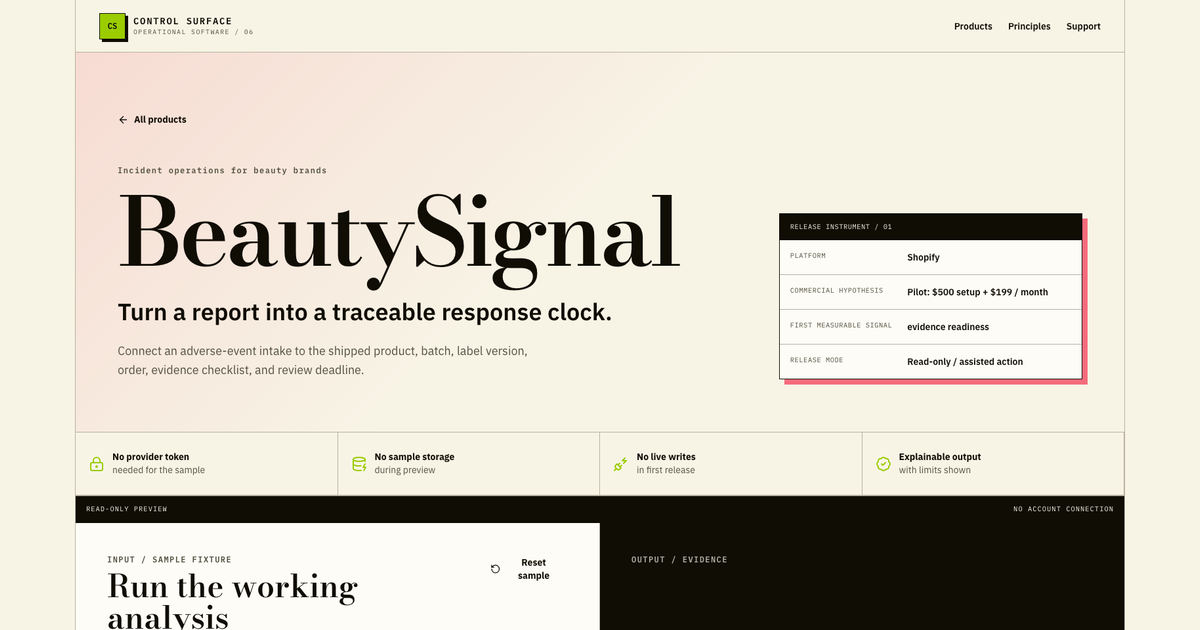
Incident operations for beauty brands

CosmeticLedger: beauty adverse-event evidence workflow

Turn a report into a traceable response clock.

Connect an adverse-event intake to the shipped product, batch, label version, order, evidence checklist, and review deadline.

No provider token needed for the sample
No sample storage during preview
No live writes in first release
Explainable output with limits shown
CosmeticLedger sample interface showing an incident evidence-readiness workflow.
Public sample interface · fictional data · no provider account connected

PURPOSE / BOUNDARY

What CosmeticLedger helps a team decide

Beauty and personal-care brands that need a traceable internal response record when a customer reports an adverse event.

  • Connect an incident report with its product, batch or lot, order, and label-version references.
  • Show which evidence fields are present or missing and calculate a review clock from supplied operating rules.
  • Create a reviewable internal workflow without making a regulatory filing or medical determination.

BUYER CHECK / RECOGNIZE THE PROBLEM

When CosmeticLedger is worth evaluating

Signals the current process is breaking down

  • A customer report sits in an inbox while order, product, batch, and label evidence live in separate systems.
  • The response team cannot quickly show which evidence has been collected and which facts are still missing.
  • Internal review dates are tracked manually without a traceable link to the awareness date and operating rule.

Who it is for

Beauty and personal-care brands that need a traceable internal response record when a customer reports an adverse event.

Who it is not for

Not for medical diagnosis, legal advice, automatic regulatory classification, or direct submission to a regulator.

FROM MANUAL REVIEW TO OUTPUT

A repeatable path to a decision

Why the current manual approach fails

Inbox threads and shared spreadsheets can record activity but make it difficult to prove which product, batch, label, and order evidence supported a decision at a particular time. CosmeticLedger groups those references around the incident and makes missing evidence visible.

  1. Record the intake

    Capture the awareness date, supplied severity, and the minimum incident references without adding a medical conclusion.

  2. Link the evidence

    Associate product, lot, order, label version, reporter details, and the configured evidence checklist.

  3. Run the response clock

    Show missing items and a review deadline calculated from the customer-supplied operating calendar.

READ-ONLY PREVIEW
NO ACCOUNT CONNECTION

INPUT / SAMPLE FIXTURE

Run the working analysis

Edit the sample if you want. This preview is processed in memory and is not saved.

No writes, payments, messages, or provider changes.

OUTPUT / EVIDENCE

00

No analysis yet

Run the supplied sample to see prioritized, explainable findings here.

USE CASES / HONEST LIMITS

Where the first release fits

Good first use cases

  • Prepare an internal safety review from a customer-service intake.
  • Trace a report back to the shipped order, batch, and label version.
  • Hand an evidence-completeness view to a qualified regulatory or safety reviewer.

Limits to review before buying

  • The rule system does not decide causality, seriousness, reportability, or medical treatment.
  • Deadlines depend on correctly configured jurisdictional and operating rules.
  • No authority, customer, clinician, insurer, or marketplace is notified by the public preview.

SOURCE-BACKED CONTEXT

Verify the platform facts

The FDA’s official cosmetics registration and product-listing hub is a primary reference for US facility and product-listing information. CosmeticLedger does not interpret that material as legal advice; the applicable event workflow, deadline, and filing decision must be approved by qualified people.

CLEAR ANSWERS / BEFORE CONNECTION

Questions about CosmeticLedger

The public sample demonstrates the diagnostic rule system. Provider permissions and customer-specific coverage are verified before a connected pilot.

What does CosmeticLedger organize after an adverse-event report?

It links the intake to product, batch or lot, order, and label references, then shows which evidence fields are present and which still need review. The goal is a traceable operating record rather than scattered messages.

Does CosmeticLedger decide whether an event is reportable?

No. The software can apply customer-supplied workflow rules and deadlines, but qualified people remain responsible for medical, safety, legal, and regulatory decisions.

Does the first release submit reports to a regulator?

No. The sample and planned first release do not file, notify, or transmit a case to a regulator. A filing integration would require separately validated jurisdiction, schema, authorization, and human approval controls.

Can a readiness score prove compliance?

No. Readiness only describes the evidence checked by the configured rule set. It cannot prove that the facts are complete, the classification is correct, or every applicable obligation has been met.

PRACTICAL GUIDES

Explore the workflow before a pilot

PAID VALIDATION GATE

The connected edition opens after a feasibility review.

We verify API coverage, permissions, data retention, and the exact paid workflow before connecting production accounts. This keeps early customers out of an unsafe beta.

Indicative launch pricing: Pilot: $500 setup + $199 / month. Final scope, price, tax, deliverables, and refund terms are agreed before paid work begins.

Request a paid pilot review